2026-06-22 · Agentic Realism
Agential cuts: every digital boundary is a decision
What Karen Barad means by a cut, explained with folders, doors and agents
A polite agent can still be blind. RAG, tools, memory, handoffs: every limit draws a world. Make the cuts legible, revisable, assumed.
I. A polite agent can still be blind
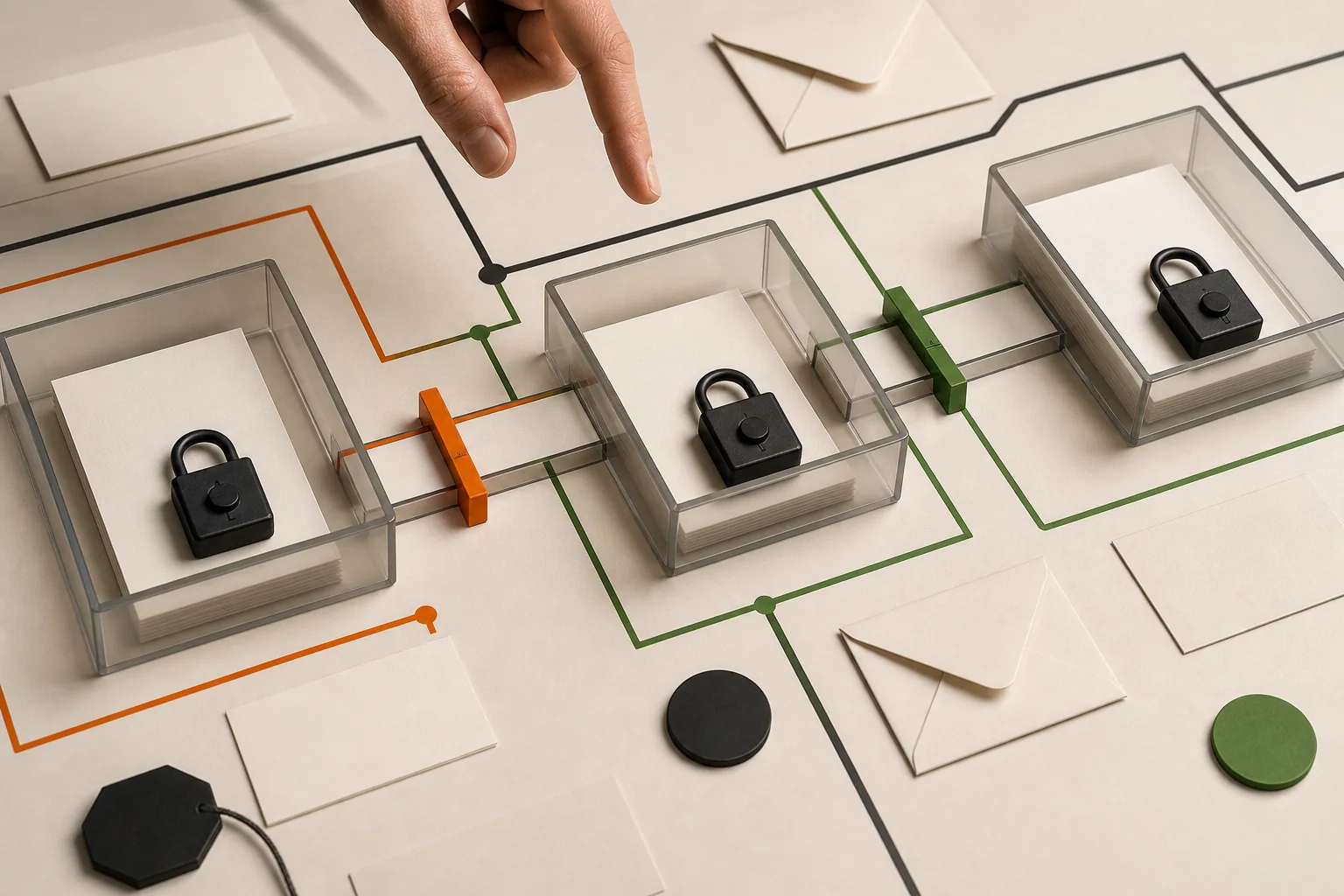
An agent can answer calmly, get three facts right, and miss the point. It did not “forget”. The file was never in front of it. The last quote sits in another folder. The client lives in the CRM, not in this session. The family photo is on the same disk as the site photos.
We then blame a weak model, or a bad prompt. Often the problem is simpler and worse: the system has already decided what counts as a world. Some paths exist for it. Others do not.
These trenches are not engineering trivia. They are decisions about what can be seen, said, sent, forgotten. The physicist and philosopher Karen Barad calls them agential cuts.
A cut says what enters the agent’s world, and what does not.
II. What Barad means by a cut
In Meeting the Universe Halfway (2007), Barad writes about measurement. Not as a neutral gaze on an object already there. As an apparatus: a setup that makes some things visible and leaves others out of frame.
A microscope is not a clear window. It chooses a scale, a light, a frame. What it makes sharp becomes discussed, measured, acted on. What it leaves blurry does not enter the report. Barad calls that a cut: the world produced by the apparatus is not the whole world. It is the world this apparatus makes possible.
We are not pinning a chatbot theory on Barad. What follows is an interpretive extension. A digital agent is also an apparatus. Its folders, permissions, memory, tools and human stop-points decide what exists for it during a task.
Listing three folders in a skill says: the project lives here. Forgetting the CRM says: the client does not exist for this session. Allowing a mail to be read and forbidding send says: you may prepare, you may not commit.
The cut is not a bug. Without it there is no targeted action. An agent that “sees everything” is not more responsible. It is only more dangerous, and often more confused.
III. The problem is not cutting. It is pretending you did not cut
A good cut is narrow, spoken, and revisable. You can show it to someone else. You can change it when the work changes. You can say why this folder stays outside.
A bad cut is implicit. Nobody wrote it down. It arrives by default: a connector that is too wide, a memory that swallows the whole thread, a send tool plugged in “to go faster”. Then we talk about the agent as a neutral assistant, after some doors are already open and others shut.
A prompt is not a permission. Writing “be careful” in a system message does not close an access. Real care lives in the perimeter: what the agent may read, what it may only draft, what a human must validate.
- 1ReadSee the useful file
- 2PrepareWrite a draft
- 3CommitSend, pay, sign — after a human
IV. Three scenes, the same models, three worlds
A landscaper asks an agent to prepare a quote. Photos of the slope are useful. Photos of the children’s birthday, taken with the same phone, are not. If the whole Downloads folder is open, the agent did not turn malicious. The cut was too wide.
Cut too wide
- Slope photos
- Quote
- Family album
- Private notes
Assumed cut
inside the agent’s world
- Slope photos
- Site quote
out of frame
- Family album
- Private notes
A practice receives appointment mail and admin papers. The agent can sort times, reread a form, prepare an acknowledgement. Clinical notes stay out of frame. If you plug in the whole inbox “to keep it simple”, you have decided that care may circulate like a quote. That is not an optimisation. It is a decision about the dignity of a file.
Two agents hand a task over. The first saw the whole thread, including a private remark. The second receives only a brief: object, deadline, decision needed. That difference is a handoff cut. It protects, or it amputates. You need to know which one you made.
In a concrete stack, the same decisions return:
- Indexed documents: the public site, internal procedures, or personal notes as well?
- Tools: read, draft, edit a file, send, pay?
- Memory: what becomes a lasting note, and what dies with the session?
- Human roles: who validates, who signs, who can stop?
Two organisations can buy the “same” model and paste the “same” prompt. They will not have the same agent. Their cuts differ. That follows from intra-action: the agent does not sit beside the apparatus. It comes into being with it.
V. “It’s just an assistant”
Product talk likes smooth sentences: the AI reads your data, the agent acts for you, everything is connected. In practice the AI reads what you plugged in. It acts where a door was opened. The rest does not exist for it, even if it exists for you.
To naturalise a cut is to treat a configuration as a given. You no longer hear that a choice was made. When the system fails, we blame the model (“it hallucinates”) or the person (“they asked badly”). We rarely look at the boundary: too wide, too narrow, or impossible to correct without breaking everything.
A context hallucination is often an unspoken cut. The agent fills in what it cannot see. It invents the client, the price, the tone, because the real file was not in its world.
VI. What we do with cuts
Agentic Realism, Response-able AI does not promise an agent without borders. That would be a bad promise. We want cuts that are legible, revisable and assumed.
Legible: you can write them on a page, in a skill, in a permission list. Someone else can reread them. Revisable: a change of work should not require rebuilding the whole stack. Assumed: you can argue about them. “Why doesn’t the agent have the contracts?” is a good question. A hidden border only produces frustration.
In our vocabulary, the DNA Dossier is a project’s active memory: what we decided to keep at hand. Every cut draws its edge. The ExoBrain is that memory made operable: linked pages, sources, contradictions, next steps. The Torus is the circulation: files, tasks, permissions, traces, and the point where a human takes the hand back. Agents are organs of action there, not the centre.
Response-ability, the capacity to respond, starts here. Knowing where the system drew the line. Being able to come back with judgment: taste, care, direction. Without that you have speed. You do not yet have responsibility.
VII. Five questions, one page
If these questions fit on one page, the cuts are starting to serve someone.
- Which paths can the agent read, and which are absent by choice?
- Which external actions are possible without human validation?
- Where is lasting memory written, and who can correct it?
- What stays out of “context”: noise, sensitive data, old versions?
- Who can change these borders without redeploying everything?
If nobody can answer, the cuts are already working. They are only working without you.
VIII. When a border loses the thread, and when it keeps it
A cut that is too wide mixes worlds. A cut that is too narrow amputates the craft. In both cases context fragments. We call that operational entropy: you start over, you repeat yourself, you invent what already existed elsewhere.
An assumed cut does the opposite. It lets living context accumulate where it should live. Intent, memory and action draw closer. We call that syntropy: not a miracle, an architecture that stops scattering everything.
That is why privacy is not a separate chapter. It is a family of cuts. The article Confidentiality is an architecture describes the doors. This one describes the gesture that places them.
IX. What this changes tomorrow morning
Every digital border is a decision about possible worlds. Making them visible is the minimum for an AI that holds in a small firm, a practice, a life that is already full. Not an AI that speaks louder. A system that knows where it stops, and leaves the human with taste and direction.
Next in the series: diffraction, reading several angles instead of one mirror answer. Then entropy and syntropy more fully, everyday response-ability, and living context as the advantage when everyone has the same models.
Sources and references
Karen Barad — Meeting the Universe Halfway (Duke University Press, 2007): agential cuts, apparatus, agential realism. Application to AI systems: an interpretive extension by Agentic Realism.
- Agentic Realism — Manifesto (2026): DNA Dossier, ExoBrain, Torus, intra-action, agential cuts, diffraction, syntropy, response-ability, living context.
- Agentic Realism — Core Doctrine (2026): cuts, diffraction, human layer, entropy/syntropy.
- Article Intra-action (2026).
- Article Confidentiality is an architecture (2026).