2026-10-21 · Agentic Realism
Our data, their timetable
Up to seven days to receive a ChatGPT export, then twenty-four hours to download it: what one installation taught me about control over our memory.
The export exists. But having rights over your content, obtaining a copy, reusing it and recovering continuity are four different things. A look at a very concrete difficulty, and how it changes the way we build with AI.

Not starting from scratch
I recently set up a personal agent for someone close to me. A practical question soon arose: what should we do with their ChatGPT history?
The idea was not to scoop everything up. Simply not to start from scratch: to find the exchanges that mattered, then choose together what deserved to join the new workspace.
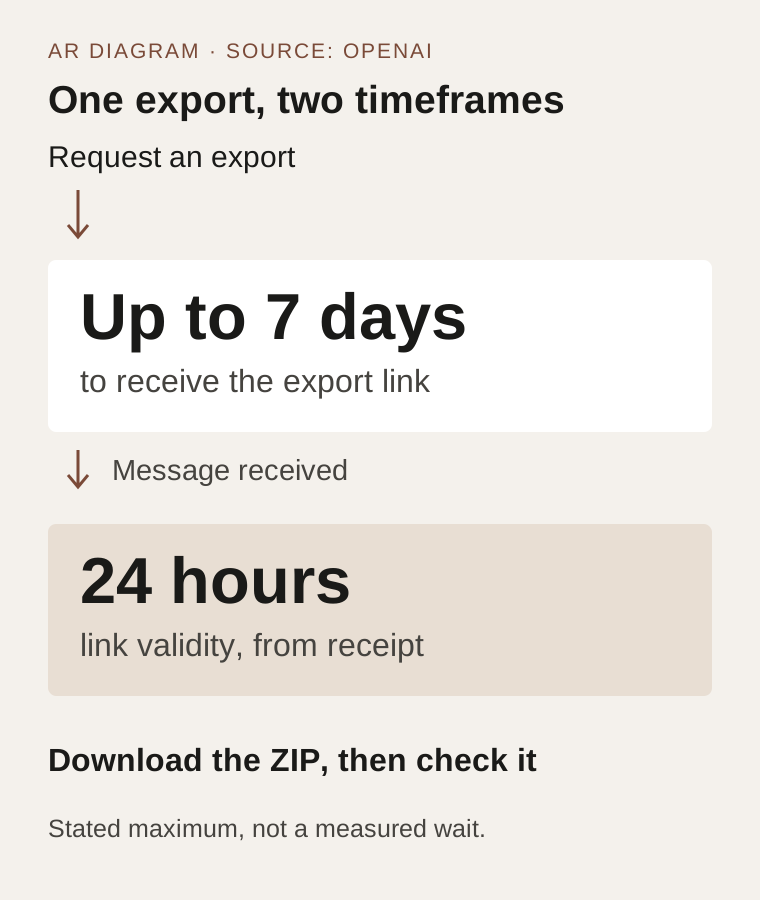
While looking for a way to retrieve this history, I discovered the export procedure. OpenAI’s documentation is clear: the export can take up to seven days to arrive, and once the message is received, the download link expires after twenty-four hours.[1]
I did not experience a week-long wait: seven days is the stated maximum, not a delay I measured. But reading those two figures in the middle of an installation is enough to raise a very ordinary question: why is retrieving your own work so much less straightforward than viewing it?
Every conversation is there in the interface, a click away. Getting the whole collection out, to continue elsewhere, means going through another door, with its own timetable.
It is this gap that interests me. Not to put a tool on trial, but because it reveals where our working memory actually lives.
The export exists. So does the friction.
Let us be precise: ChatGPT does let people retrieve their data. OpenAI documents two routes: account settings, for eligible plans, and a privacy portal. The archive delivered is a ZIP file containing the conversation history and other account data.[1] I am describing the route I found and that the documentation sets out; I am not claiming that no other route exists.
But “the export exists” does not close the discussion. In practice, you need to:
- submit the request;
- wait for the archive to be prepared, up to seven days;
- watch for the email or text message announcing it;
- download it within twenty-four hours, while signed in to the account that made the request;
- open the ZIP file and check that it contains the expected conversations.
If the link expires, you have to start again: another request, another wait. And the export does not bring back conversations that have already been deleted.[1]
None of these steps is insurmountable. But each requires you to be available at the right moment. For someone discovering these tools, travelling or not checking their email every day, a twenty-four-hour window is no small detail.
A conversation archive can be highly sensitive, and limiting a link’s lifetime may serve an understandable security purpose. The documentation does not explain the specific choice of twenty-four hours, and I see no intention to hold anyone back.
The difficulty lies elsewhere. At the very moment when you want to continue differently, you still depend on the pace and rules of the service you have been using until then. Our data, their timetable.
What we want to take with us goes beyond messages
Take an imaginary example. An independent watchmaker uses AI to prepare correspondence, compare wording and think about how to present a new piece. They do not share their manufacturing secrets with it. Yet, over the weeks, something takes shape: a vocabulary, preferences, corrections, the reason a particular turn of phrase was rejected because it sounded too commercial.
A single exchange contains sentences. A series of exchanges tells the story of how a decision took shape.
Another imaginary example: a lighting designer. A discussion begins with a translation, moves towards a text about a work, then returns a few weeks later to a finer question: how do you talk about light without reducing the piece to a product specification?
These two characters were invented for the examples; they are not clients. They illustrate what we at Agentic Realism call living context: the connections between documents, intentions and decisions that we can find again, correct and develop.
It is this context that I did not want to abandon during the installation. Not a volume of text to accumulate on principle.
An archive is not a move
OpenAI’s own documentation provides a useful distinction. To move conversations from one ChatGPT account to another, it suggests exporting your data, then uploading the conversation file into a new chat, where it will serve as a reference. It specifies that this is not a complete migration: the old conversations do not reappear individually, the original sidebar is not restored, and custom instructions, memories and other account settings do not follow.[2]
This case concerns a transfer between two ChatGPT accounts, not the setup of a personal agent. But it clearly shows the difference between accessing content and recovering your working environment.
A ZIP file can be an excellent archive without being immediately usable memory. The download completes a procedure; it does not complete the work of picking things up again.
Ownership is not enough for autonomy
Then there is the question of rights. OpenAI’s terms of use applicable in Europe, including Switzerland, state that, as between the user and OpenAI and to the extent permitted by applicable law, users retain their rights in what they provide and own what the service produces.[4]
This is a contractual clause, not a universal guarantee. The same terms note that an answer may not be unique, since other users may receive similar outputs, and that OpenAI may use content to provide, maintain, develop and improve its services.[4] “Owning” therefore means neither exclusive rights to a turn of phrase nor use reserved for you alone.
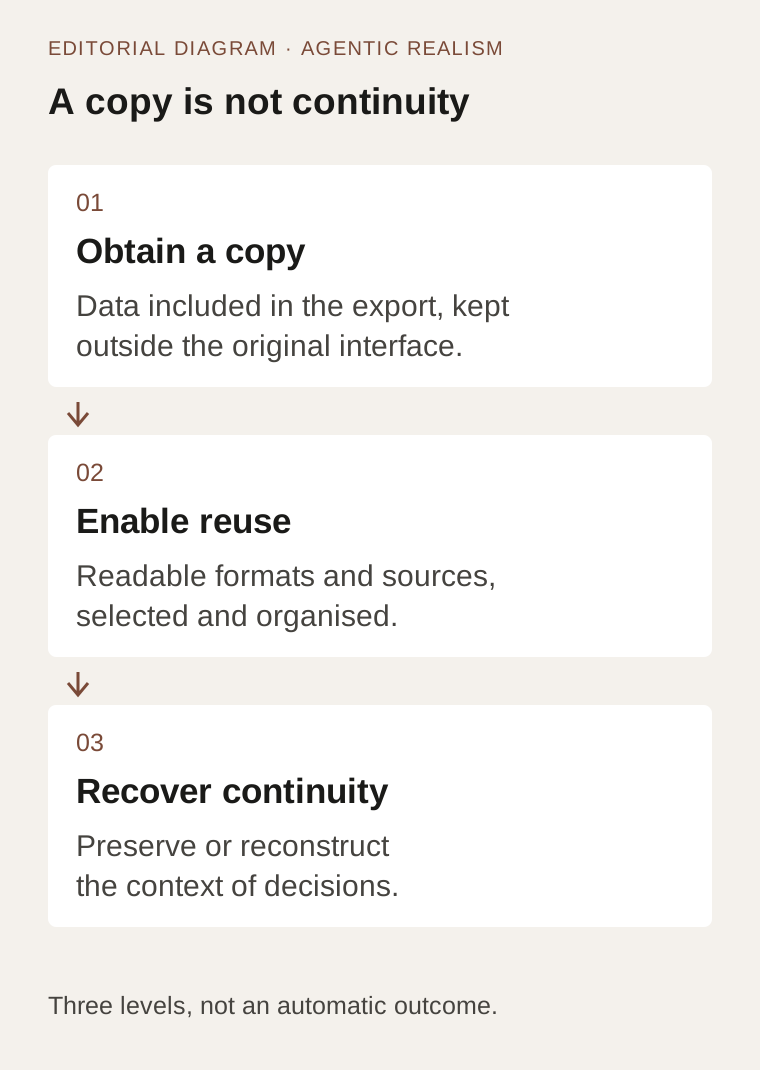
Above all, ownership does not answer the question raised by my installation: what means do we actually have to take our work back? Four levels overlap without being interchangeable:
Having rights → what the contract and the law recognise in relation to the content.
Obtaining a copy → actually receiving the files.
Being able to reuse them → reading, sorting and organising them.
Recovering continuity → connecting sources, decisions and projects in a new workspace.
A reading framework proposed by Agentic Realism; it does not describe ChatGPT’s internal workings.
You can be on solid ground at the first level and still stumble at every level that follows.
One last confusion to clear up: portability is not the same question as model training. OpenAI offers a setting that excludes new conversations from training without removing them from the history. There is an exception worth knowing: if you voluntarily provide feedback, such as a thumbs-up or thumbs-down, the entire associated conversation may be used for training.[3] This setting governs one use of the data; it says nothing about how easy it is to leave.
“Private”, “mine” and “retrievable” are three different promises. None guarantees the other two.
Keeping a space of our own, without giving up good tools
I do not conclude that we should stop using ChatGPT. We can appreciate a service and take a clear-eyed look at the dependency it creates in the way we work. OpenAI itself writes in its terms that it does not commit to offering its services indefinitely, or in their current form.[4] This is an honest clarification. It is also a good reason not to entrust a project’s entire continuity to a single history.
The response we are trying to build is concrete. After a useful work session, we keep the approved text, the necessary references, the decision made and what remains to be checked in a space we choose. The conversation history remains one source among others; it no longer carries the project’s memory on its own.
An agent can help maintain this space: find a source, prepare the context for a task, flag what is missing. It should not decide on its own to import our entire history into it.
Because bringing everything back is not always desirable. A history may contain confidences, information about other people, abandoned experiments and incorrect answers. We need to be able to sort, exclude and correct. An old model response does not become a fact because it appears in an archive.
This requirement also applies to what we build. Installing an agent on a dedicated machine does not make a system private or autonomous by nature. We still need to know who can access it, where the backups go, which formats are used, which processing relies on external services, and how to leave the setup.
The person for whom I set up this agent must one day be able to do without it, take their files and continue without us, without depending on our timetable. The ability to leave must also apply to us. Otherwise, we would merely have moved the dependency.
Test the exit before you need it
For an individual or a workshop, a first exercise can remain very simple. Choose a project with no sensitive stakes. Gather its sources and decisions in a folder under your control. Then try to pick it up again without reopening the old conversation account.
Are the files readable? Are the decisions understandable? Can you distinguish what was approved from what was only a proposal? Can another tool help you continue without pretending to bring the old assistant back exactly as it was?
This test is worth more than a grand promise of sovereignty. It shows what is missing while there is still time to get organised.
The export offered by a platform remains valuable: it is worth requesting it, downloading it in time and keeping it carefully when you need it. But continuity can also be built as you work, rather than proving fragile on the day of a change.
In the end, this installation comes down to an elementary question: when we entrust work to an AI, where do we keep its memory?
We want tools that can accompany us for a long time. We also want to be able to continue without them.
Documentation consulted on 21 October 2026; service features and terms may change. This article distinguishes a reported experience, the procedures documented by OpenAI and a proposed method from Agentic Realism. It is not legal advice and does not measure the delays actually experienced by users.
Sources
- [1] https://help.openai.com/en/articles/7260999-how-do-i-export-my-chat-history-and-data — Exporting your ChatGPT history and data | OpenAI Help Center
- [2] https://help.openai.com/en/articles/9106926-transferring-conversations-from-1-chatgpt-account-to-another-chatgpt-account — Transfer exported conversations between ChatGPT accounts | OpenAI Help Center
- [3] https://help.openai.com/en/articles/7730893-data-controls-faq — Data controls in ChatGPT | OpenAI Help Center
- [4] https://openai.com/policies/eu-terms-of-use — Europe Terms of Use | OpenAI