2026-08-14 · Agentic Realism
A useful agent needs a desk — not only a model
Grok Bot, agentic workspaces and AlpenDock
An agent that truly works needs context, boundaries and human takeover. What Grok Bot makes visible — and why AlpenDock should only be used when an isolated workspace creates real value.
I. An answer is not yet a workplace
Most AI demonstrations show us an answer in a window. We ask a question, copy a text, then close the tab. That can be useful — sometimes genuinely impressive. But when an idea has to become a quote, research, a dossier, a prototype or a decision followed over time, a conversation alone is no longer enough.
Work leaves traces: files, tools, versions, habits, exceptions and things to pick up again tomorrow. It needs a place to stay. A useful agent does too.
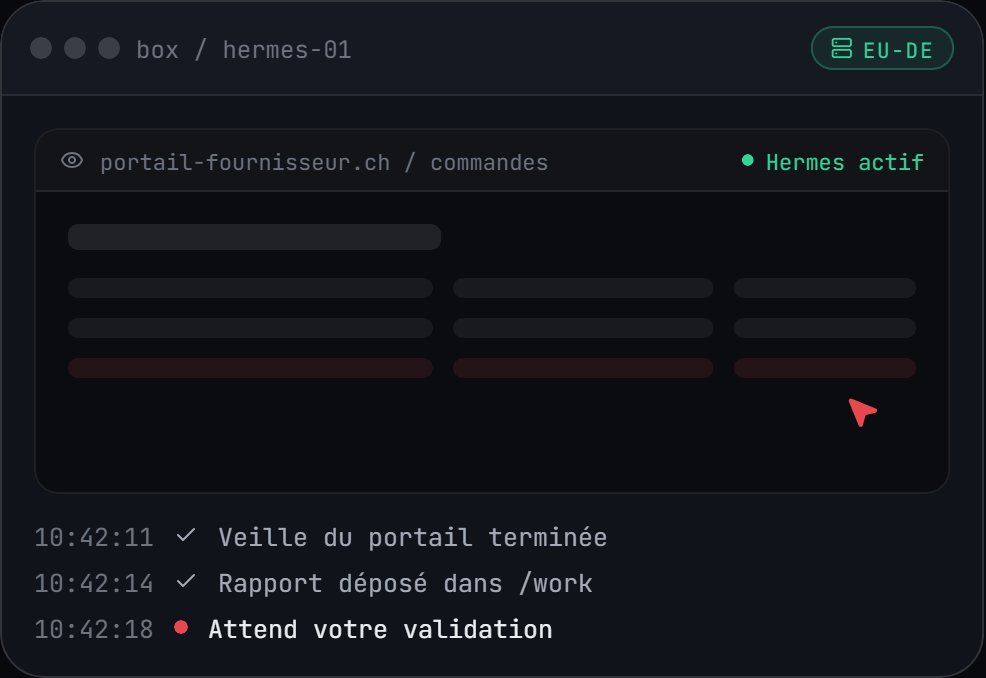
An agent is not only a model that answers. It is a situated digital collaborator: it has a mission context, bounded access, memory and a human who can inspect it or take control back.
This is the category shift now emerging in consumer products: AI is gradually leaving the conversation alone and entering persistent working environments.
II. What Grok Bot's launch makes visible
With Grok Bot, xAI and Cursor make that idea tangible: a bot can work inside a persistent cloud computer, with a browser, files, a terminal, applications, connectors and routines. A human can observe the screen and take over when a password, strong authentication, CAPTCHA or sensitive decision requires it.
This matters less because it would promise an “AI employee” than because it makes agentic work visible. An agent can keep files, move between sites, reuse a procedure, stop and hand over a working state rather than rebuilding context from zero in every conversation.
Early feedback is also a useful reminder: giving an agent a computer does not solve everything. Sign-ins, sites without APIs, CAPTCHAs, datacentre IP restrictions, latency and poorly scoped permissions remain real sources of friction. Persistence is a useful condition; it is not magic.
III. A separate screen is not yet a boundary
This is where infrastructure becomes a question of trust. Grok Bot's documentation explains that bots owned by one user can share the same cloud computer: files, cookies, browser sessions and CLI credentials. Separate screens can create an impression of separation; by themselves, they are not security boundaries.
For one person experimenting alone, that sharing may be convenient. For an agency, multiple projects, an SME or sensitive information, more precise questions must be answered: which mission can see which files? Which credentials are available? What travels to an external model or SaaS? Who can review an action, interrupt it or undo it?
These are not details reserved for security teams. They are the conditions that let a small organisation use an agent without turning its work into a black box. A prompt is not a permission. A rule written in a conversation does not replace separated access, secrets and environments.
IV. What an agentic workspace must actually provide
A real agentic workspace is not simply a server with a new name. It is a working environment designed around a mission, with explicit boundaries. Depending on the need, it can include a persistent browser, working files, a terminal, authorised connectors and mission memory. But it must also make its limits visible.
- A bounded context. The files, tools and data required for the mission — not the whole digital life of a person or organisation.
- Separated access. Secrets, accounts and permissions kept outside model instructions, with a scope suited to the client, project or mission.
- Observable action. A screen, useful journal or report that makes clear what the agent prepared, did, requested or blocked.
- Real human takeover. Pause, approval, correction and recovery are not embarrassing exceptions; they are part of the system.
- Reversible continuity. Tested backups, recovery and rollback; a way out must not depend on one person or one browser tab.
V. AlpenDock: a delivery component, not an automatic promise
That is the direction of AlpenDock: when it is needed, provide a persistent, isolated and supervisable agentic working environment. The aim is not to sell an “agent platform” before understanding the work. The aim is to give an agent a reliable desk when the workflow cannot be delivered in a simpler, safer or more transparent way.
Agentic Realism designs the business system, its boundaries and its continuity. AlpenDock can provide the isolated desk in which an agent works when that desk creates real value.
That distinction matters. The starting point remains a concrete problem: an enquiry that gets lost, a quote waiting too long, photos and documents scattered between tools, research that is never resumed, or administrative preparation taking time away from the craft. An agent can first read, organise, research, prepare a draft or propose a next action. Not every task needs a persistent computer.
AlpenDock becomes relevant when the work genuinely needs a durable browser, applications without APIs, active files, a terminal, a session that must survive across days, or precise visibility into what is happening. At that point, a dedicated environment per client, project or sensitive mission can reduce improvised setups, clarify responsibility and make maintenance easier.
VI. The right sequence: start with the workflow, then the desk
The mistake would be to begin with infrastructure because it is attractive. A small business is not looking for a virtual machine, a model or an “autonomous” agent. It wants to stop losing the thread between enquiries, clients, documents and next actions.
- Look at the real workflow. Where does an enquiry arrive? Who handles it? What repeats? What must remain human?
- Start with a bounded scope. Preparation, triage, research, drafting or internal follow-up before any autonomous external action.
- Measure and correct. What saves time, what fails, what requires permission or a better source of context.
- Add a workspace when the need is demonstrated. Persistence and computer use then become a delivery decision, not an imposed gadget.
This sequence protects both trust and budget. It prevents a complex infrastructure from being attached to a problem that an export, API, clear procedure or human approval could have solved more simply.
VII. Technology does not remove responsibility
The promise of agents working while we sleep is seductive. But the right question is not only, “what can an agent do?” It is also, “under what conditions can it do it without creating a debt of trust?”
At Agentic Realism, Response-able AI, that means naming dependencies rather than hiding them: where the environments live, which data is entrusted to which services, where models are involved, how actions are approved and how a person takes control back. Swiss or European hosting, client separation, an egress policy or rollback are not marketing words: they are properties to verify component by component before selling them.
The future will not be determined only by the brightest model. It will also depend on our ability to build the places where models work: places continuous enough to create, bounded enough to stay safe, and legible enough that the human is never absent.
A useful agent needs a desk. But a useful desk needs boundaries, memory and care.
Go further
Agentic Realism begins by looking at where your activity loses the thread — enquiries, quotes, documents, follow-up or coordination — then designs one measurable first component, without imposing a platform or opaque automation.
Start an Agentic Realism diagnostic →
AlpenDock only enters the picture if your workflow genuinely needs a persistent browser, active files, a terminal, or an isolated and supervisable environment. We can assess that need with you, without selling a workspace by default.
Assess whether AlpenDock is needed →
Also read: privacy is an architecture, agential cuts and OpenClaw or Hermes Agent in French-speaking Switzerland.
Sources consulted on 13 August 2026: xAI — Grok Bot overview, approvals, security and privacy and the independent Melvynx test. Grok Bot's features and access conditions may change. AlpenDock is presented here as an Agentic Realism delivery direction, not as a partnership with xAI or Cursor.