2026-08-14 · Agentic Realism
carbon.md: measurement to the agents, policy to the humans
Why a carbon policy file naturally belongs to Agentic Realism
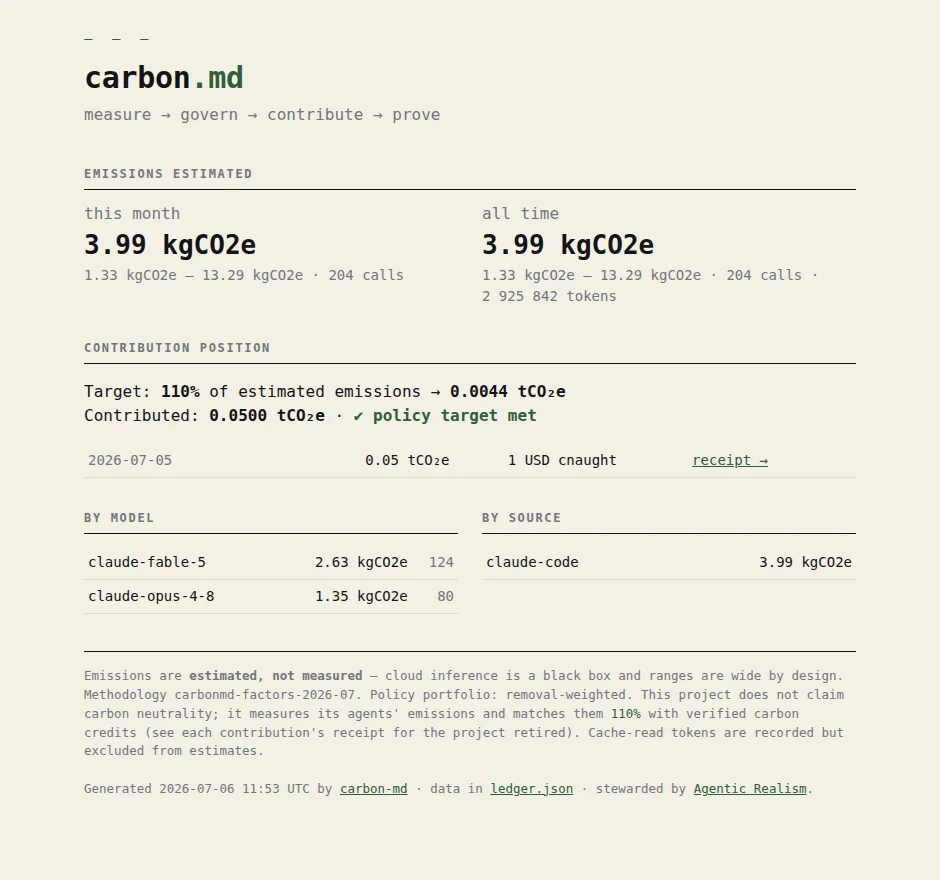
carbon.md connects agent consumption to human policy, versioned memory and verifiable traces. An Agentic Realism reading: measure, govern, contribute and prove without the theatre of neutrality.
I. AI is not immaterial because its interface is light
An answer appears in a window, then disappears. That simplicity hides what made it possible: model calls, context memory, tools, servers, networks and computation. At the scale of one request, the footprint can seem tiny. At the scale of agentic loops, fleets and tasks repeated over time, it becomes a consequence of the system that we need to be able to see.
The problem is not that AI consumes resources. Every material activity does. The problem begins when that consumption exists only for the duration of an API call, then leaves our memory. An action without a trace is hard to discuss, limit or take responsibility for.
An agent that cannot account for what it consumes is not autonomous. It is simply unsupervised.
II. carbon.md: a small boundary that changes the question
carbon.md is an open, local-first standard that places a readable file at the root of a project. That file does not pretend to solve the climate question on its own. It makes one thing simpler: declaring an agent's carbon policy in the same place where we already declare its instructions, permissions and working rules.
This is a natural idea for Agentic Realism, Response-able AI. An agentic system is never only a model. It is made of files, thresholds, accounts, human decisions, traces, material constraints and actions that still need to be approved. Carbon therefore does not arrive afterwards in a report far removed from the terrain. It enters the architecture of the apparatus itself.
A policy file can state what should be measured, how much of estimated emissions an organisation intends to contribute, what budget is authorised and above which threshold human confirmation becomes mandatory. The boundary is small, but it is legible, versionable and revisable.
III. Measurement to the agents. Policy to the humans.
This phrase captures the right place for each side. Agents can capture usage where it genuinely passes: token logs, middleware, OpenTelemetry traces or tool logs. They can keep a ledger, update estimates, prepare a contribution and stop when a rule requires it.
But agents should not decide policy on their own: what level of coverage is acceptable, what kind of contribution aligns with an organisation's values, how much money may move, or which action requires an approval. Those choices belong to the people and organisations that live with their consequences.
This is exactly the difference between automating noise and automating judgement. The agent absorbs the repetitive work of measurement and record keeping. The human keeps taste, care, direction and the right to say no.
IV. Measure, govern, contribute, prove
carbon.md organises the question into a simple loop — not to reduce climate complexity to four words, but to stop responsibility dissolving between tools.
- Measure. Capture use and translate it into CO₂e estimates with low, central and high ranges. Cloud inference remains partly opaque: an honest range is better than an invented precise figure.
- Govern. Write a human policy: target, budget, approval threshold, contribution rules and conditions for stopping.
- Contribute. Prepare or make, within the authorised scope, a contribution towards verifiable carbon removal. Spending should not be handed to an agent with neither limits nor confirmation.
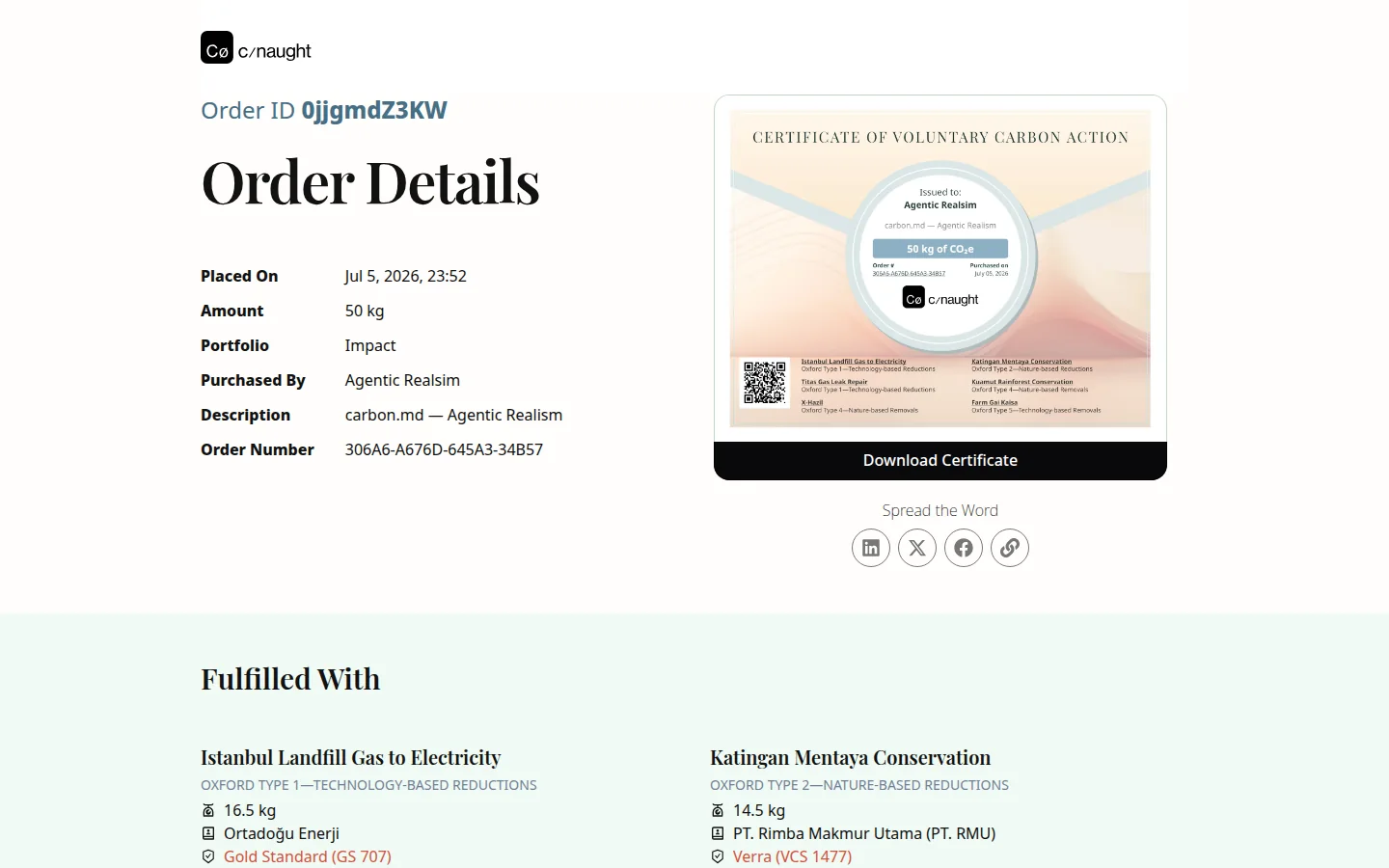
- Prove. Connect a declaration to a ledger and, when a contribution is made, to an inspectable receipt. Not a green mood; a trace that can be checked.
This loop rejects two shortcuts: helpless guilt — “it is too small to count” — and the theatre of neutrality — “a badge is enough to erase what was emitted.” Measuring does not make anyone innocent. Contributing does not remove the need to reduce. But accounting turns a vague externality into a decision that can be discussed.
V. The ledger as living context
In Agentic Realism, we call living context a memory that remains tied to a situation, evolving and revisable. A carbon ledger can be that: usage becomes memory, memory informs policy, policy guides action, then action leaves a trace for what comes next.
That continuity matters more than a polished dashboard. A sequence of dated lines, with a versioned factor methodology, visible uncertainty and recorded decisions, can be a much more useful form of memory than an annual estimate with no clear origin. The ledger does not pretend to know the world perfectly. It simply refuses to forget what the system already knows.
It is also a modest form of syntropy: making intention, actual use, memory and action converge rather than allowing every tool call to disappear into the entropy of distributed systems.
VI. An explicit agential cut
The carbon.md file is an explicit agential cut. It determines what an agent may measure, what it may propose, what it may do, and where it must wait. Like an API scope, firewall rule or payment threshold, it makes a boundary explicit instead of asking a model to remember a good intention in a prompt.
This approach is coherent with the rest of our philosophy: limits are not a failure of autonomy; they are its condition. An agent that knows its scope can act more reliably. A human who can read and change that scope keeps a real relationship with the system.
carbon.md therefore promises neither “clean AI” by decree nor moral automation. It proposes a minimal infrastructure for making the material consequences of computation visible, governable and verifiable as agents take up more space in our work.
VII. Building agents that can answer
Agentic Realism does not aim to slow innovation down for its own sake. It aims to build systems solid enough for their power to remain habitable: memory rather than forgetting, permissions rather than incantations, human takeover rather than dependence, and traces rather than promises.
carbon.md belongs naturally in that direction. It connects an agent to a material consequence without pretending that a file or receipt resolves the climate crisis. It introduces a simple discipline: what is measured can be discussed; what is governed can be limited; what is contributed can be proven; and what remains uncertain must be said as uncertain.
Agents can count. Humans must still choose what is worth doing.
Get started
carbon.md is an open standard: you can explore it, install it locally and challenge its methods. The project documents its assumptions, ranges and unbuilt features because credible responsibility begins with named limits.
Want to design an agent that also keeps track of its costs, permissions, data and consequences? Let's discuss an Agentic Realism diagnostic.
Read next: a useful agent needs a desk, privacy is an architecture and agential cuts.