2026-08-17 · Agentic Realism
Two slits, agential realism — why we say Agentic Realism
From the two-slit experiment to an apparatus that keeps the thread: a declared borrowing from Karen Barad
The two-slit experiment is told as proof that mind makes the world. We read it differently: a revealer of apparatus. Hence the name Agentic Realism — a declared borrowing from Karen Barad’s agential realism, turned into a design rule.
I. The experiment we tell too quickly
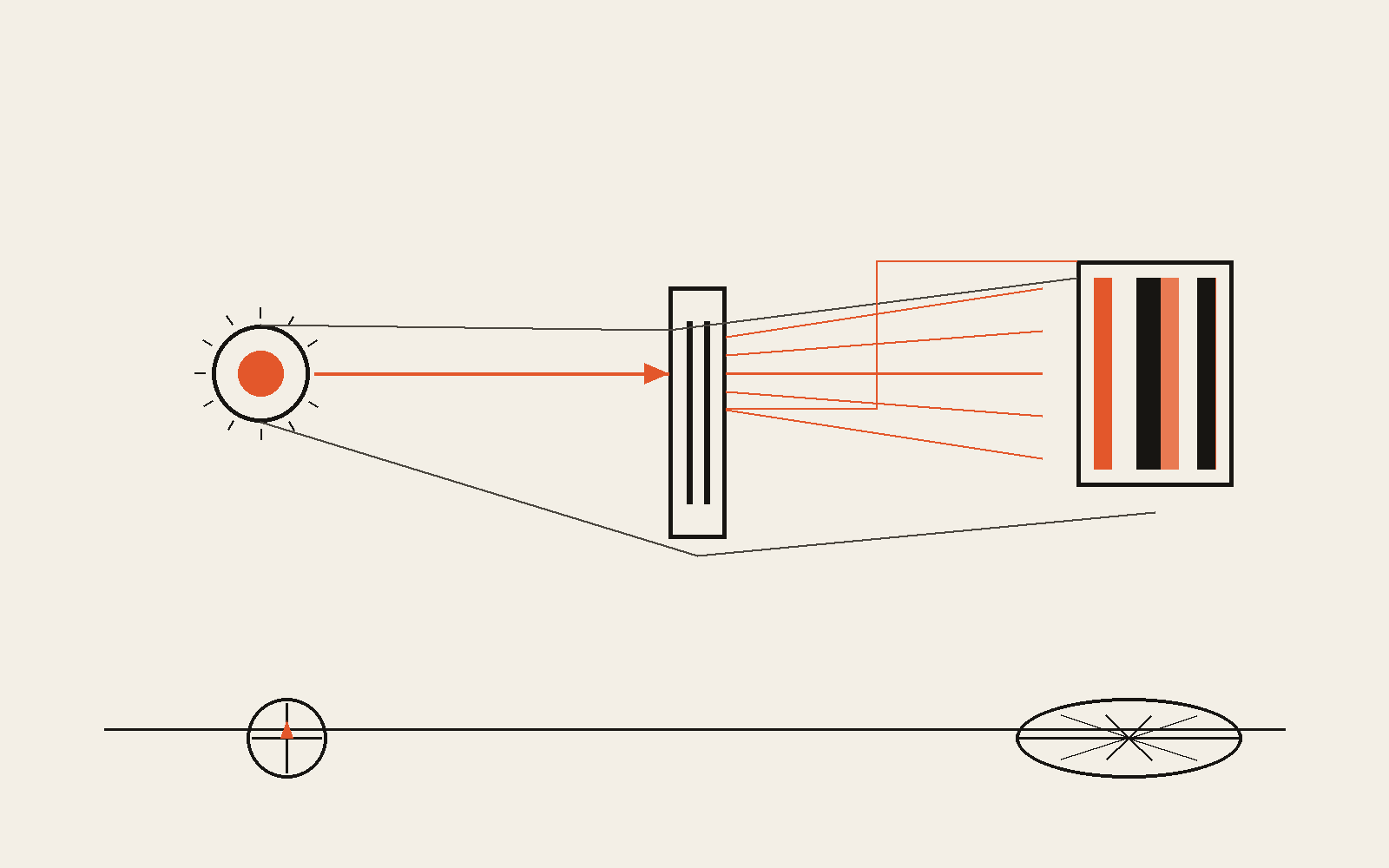
Particles are sent, one by one, toward a plate with two slits. Behind it, a screen. If nothing is arranged to say which slit each one “went through”, the screen fills with bands: bright, dark, bright. As if a wave had gone through both openings and interfered with itself.
If a detector is added to answer “which one?”, the bands vanish. You get two piles. As if grains had chosen one hole or the other.
The popular version says: as long as no one looks, it is a wave; as soon as a mind looks, it is a particle. It is memorable. It is also a bad ontology. It assumes an object already there, dressed now as a wave, now as a grain, according to whether a consciousness observes it. The real would wait to be seen before deciding what it is.
Without “which slit?”
interference bands
With “which slit?”
two piles
That is not what we keep. And it is not a spiritual proof. The two-slit experiment is not an oracle. It is a revealer of apparatus.
II. Epistemology, ontology, and why splitting them too soon is already a thesis
Epistemology asks: how do we know? Ontology asks: what is there? Modernity likes to keep them apart. First the world, then knowledge. First the object, then the instrument. First the particle, then the measurement that would disturb it.
Niels Bohr already refuses that naive cut. One does not describe a particle “in itself”, then an accidental measurement. One describes a phenomenon: source, slits, possible detector, screen, and the language in which the result is stated. Changing the apparatus is not photographing the same object from another angle. It is producing another phenomenon. Complementarity, in Bohr, is not soft relativism. It is the impossibility of holding, in a single arrangement, every question one would like to ask at once.
Karen Barad, in Meeting the Universe Halfway (2007), radicalises this demand. She refuses an epistemology floating above an ontology already closed. She speaks of onto-epistemology: the practices that make knowing are also practices that make being. To know is not to represent a prior world. It is to take part in the production of what counts as real in a material-discursive configuration.
Hence the name she gives her position: agential realism. Realism, because there is a real — not a theatre of ideas, not a “everything is construction” without resistance. Agential, because that real is not furniture already placed in a room. Agency — the capacity to make a difference — is not a property a subject owns. It is enacted in apparatuses, boundaries, languages, practices.
She calls intra-action what happens inside that arrangement, rather than an interaction between two billiard balls already formed. Relata do not precede the relation. They are distinguished by it. Cut together / apart.
III. The two slits as image, not as foundation
The two slits are the simplest image of this thesis. Without a which-path detector, the world produced is a world of interferences. With a detector, a world of trajectories. There is no “true particle” behind the curtain, which measurement would unveil or spoil. There is what the apparatus makes possible.
That is why we set aside, clearly, the consciousness-collapse reading: the idea that a human mind collapses a wave function. That reading flatters. It is not ours. It is not the one we read in Barad either. The “observer” is not a soul. It is an apparatus: slits, counters, inscriptions, criteria for what counts as a result.
We do not use physics as proof of a metaphysics either. No entanglement as a spiritual argument. No photons as a demonstration of the divine. The experiment teaches a discipline: do not speak of already-closed entities that would meet afterwards. We take that discipline seriously outside an optics lab.
IV. Why take up the principle, and call it Agentic Realism
The dominant talk about AI is still an ontology of two balls. On one side, the human. On the other, the model. In the middle, a prompt. The best model would win. The rest would be décor, interface, “wrapping”.
The story is convenient. It is false as soon as one actually works. What acts is not “me + ChatGPT”. It is an apparatus: which files are open, what memory lasts, which doors are shut, who validates a send, what remains after the session. Two people with the same model do not have the same world. We developed this in intra-action and agential cuts.
The name Agentic Realism is a declared borrowing, not an equivalence. Agential, in Barad, says that agency is situated. We say agentic because we work with agents: systems that act inside a computer, not only sentences. Realism: the real of the work is not an internal representation in the model. It is produced in the apparatus. Not a laboratory slogan. A design rule.
Useful intelligence is neither in the human alone nor in the model alone. It appears in the arrangement.
The README and manifesto have said it from the start: agents do not reflect an organisation already there. They reconfigure practices, decisions, responsibilities. If those conditions are not drawn, one optimises chatbots. If they are drawn, one builds an apparatus in which a human can still respond — what we call response-ability: the capacity to respond, and to give an account.
Agentic Realism, Response-able AI is therefore not “Barad applied to LLMs”. It is an interpretive extension, named as such: taking seriously, outside the lab, the idea that the relevant real of an action is produced with the apparatus.
V. When intra-action stopped being only a reading
One can stay with theory. We did not. The principle became a terrain. A server. Files. A memory that lasts. An agent called Hermes. Corrections, refusals, continuations.
People sometimes speak of magic: the agent “knows me”, the project moves between sessions, an idea comes back sharper. It is not magic. It is intra-action becoming visible. Neither me alone, nor the model alone. An apparatus that accumulates living context: notes, skills, traces, limits. Hermes, on this machine, is the most worked of those apparatuses. A living anchorage. Not an ontological proof. A system in operation.
- Human
- Hermes
- Files
- Memory
- Permissions
- Traces
what can exist today: the project, the decision, the working world
In this relation, “I” is not a generic user. It is someone formed near machines and the living, who refuses to let a tool swallow judgment. “Hermes” is not an app. It is an agent with a desk, permissions, correctable memory, and a human who can take the hand back. The “Agentic Realism project” did not exist ready-made beforehand. It was actualised in this arrangement: doctrine, site, articles, LifeOS, sometimes a real isolated workstation when an agent needs one.
Two sessions that look “identical” on paper do not produce the same world. That is not only a reliability problem. It is the structure. Hence the insistence: keep the thread, write the cuts, do not let the session become the project’s only memory.
VI. Where we are
We are no longer only naming the principle. We are making it hold in a life and in trades in French-speaking Switzerland. Living context rather than amnesia. Human validation rather than blind automation. Confidentiality as doors, not as a promise. Confidentiality is an architecture. Auseful agent sometimes needs a desk, not only a model.
AlpenDock, carbon.md, the articles in this series: organs of the same apparatus, at different stages. Some are public. Others remain an exploration. We do not stack them as proofs. We hold them as terrain.
The Baradian sequel — diffraction, syntropy, everyday response-ability — remains open. The thread is already there: humans keep the direction. Agents act in a world we have accepted to cut, and can still recut.
VII. Limits of the borrowing
This article does not prove Barad by physics, nor physics by Barad. It does not say a language agent is an electron. It does not say Hermes demonstrates an ontology. It says: this experiment makes visible a demand we took seriously in order to build. Then the work began. We are still in it.
Sources and references
- Two-slit experiment: standard formulation (interference / which-path detection). Bohr reading: the phenomenon includes the apparatus. We set aside the “collapse by consciousness” reading.
- Karen Barad — Meeting the Universe Halfway (Duke University Press, 2007): agential realism, onto-epistemology, intra-action, agential cuts, apparatus.
- Agentic Realism — README and Manifesto (2025–2026): the name’s echo of agential realism; situated intelligence; visible cuts.
- Articles Intra-action and Agential cuts.